How a planetary set shares load, why planet count changes torque capacity, and what each of the three gear types is asked to do.
2026-07-15 · База знаний
A planetary gear set has three elements: a sun gear in the centre, three or more planet gears meshing with it, and a ring gear with internal teeth surrounding them all. The planets are held by a carrier. Depending on which element is fixed, the set works as a reducer, an overdrive, or a differential — which is why the same hardware appears in automatic transmissions, hub reducers and final drives.
Load sharing is the whole point. In a simple pair of gears, all torque passes through one mesh. In a planetary set it is divided among the planets, so four planets can carry roughly four times the torque of a single mesh of the same size — provided the load is actually shared evenly, which is a manufacturing question rather than a design one.
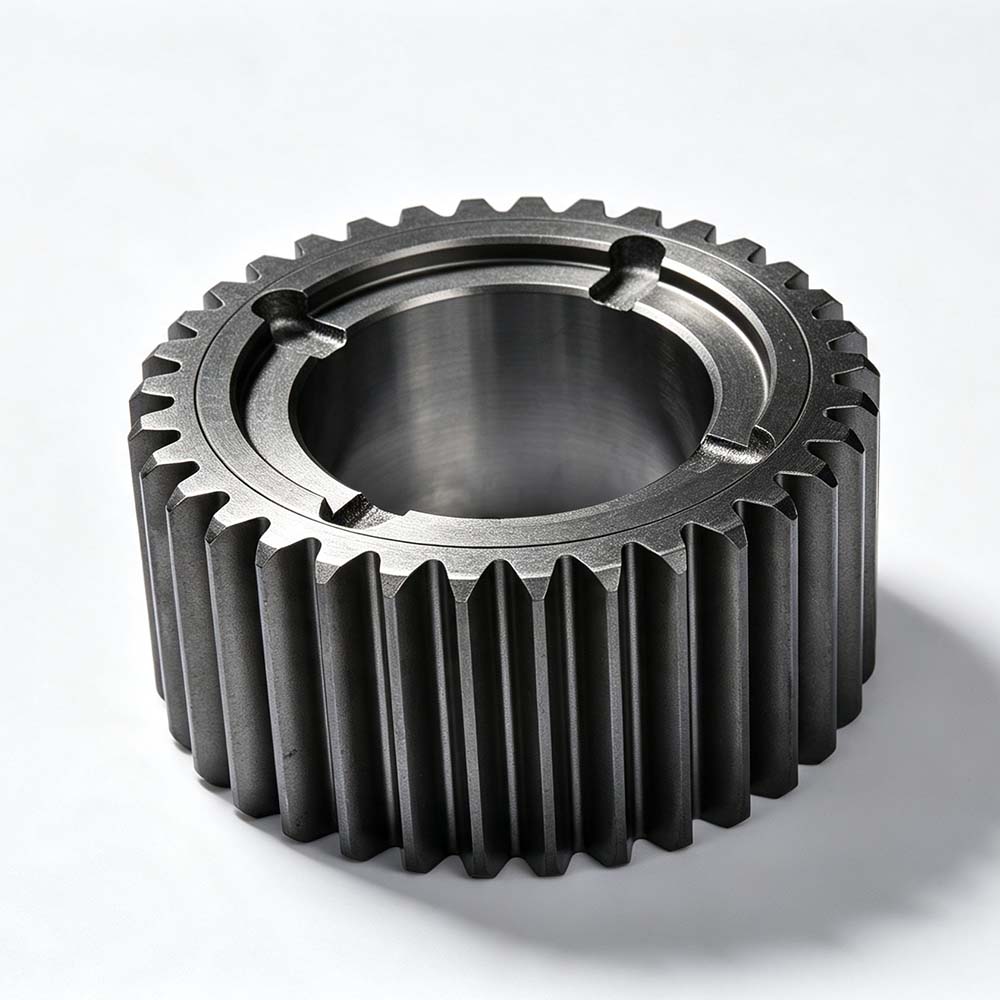
Each element has its own manufacturing character. Sun gears are small, highly loaded and usually carburised with tight profile tolerance. Planet gears are the most numerous part and dominate cost, so forging them near-net is attractive. Ring gears are large and thin-walled; internal tooth cutting and heat-treatment distortion control are the hard parts.
For buyers, the practical consequence is that a planetary gear quotation should state planet count, accuracy grade and the load-sharing assumption. Two suppliers quoting the same drawing can be quoting two very different manufacturing processes, and comparing only the price per piece hides that difference until the first noise complaint.